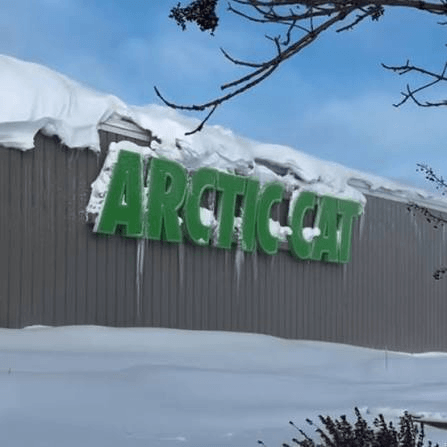

In late 2024, headlines and YouTube videos made it sound like Arctic Cat was finished. Layoffs hit the Minnesota factory. New snowmobile production stopped. The parent company publicly said it was looking for a way out. For a lot of riders and dealers, it looked like the end.
But the full story is more complicated — and it has changed significantly since then. Here is a clear, chronological breakdown of what actually happened, who bought the brand, and where Arctic Cat stands right now for buyers, dealers, and existing owners.
Arctic Cat Did Not Go Out of Business — Here Is What Actually Happened
Let’s get the most important point out of the way first: Arctic Cat never filed for bankruptcy and was never legally dissolved. No credible source documents a formal bankruptcy filing or a corporate liquidation of the brand.
What did happen was this: Textron, the parent company, suspended new snowmobile production and laid off roughly 380 to 400 employees at the Thief River Falls, Minnesota facility. That combination — factory layoffs plus a halt on new models — looked a lot like a shutdown from the outside.
But there is a real difference between pausing production and going out of business. Think about a car manufacturer that stops building new models for a year while it restructures. If it keeps selling existing inventory and supplying parts to dealerships, it is not “out of business” in any legal or operational sense. That is essentially what happened here.
Textron also stated publicly that it was exploring “strategic alternatives” for Arctic Cat — industry language for putting the brand up for sale, not shutting it down. While no new 2026 sleds were being built under Textron, the company committed to continuing parts production and dealer support for existing machines.
How Textron’s Ownership Set the Stage for the Crisis
Arctic Cat was founded in 1960 and built a strong reputation as an American snowmobile and ATV brand. The company is based in Thief River Falls, Minnesota, and has loyal customers who take the brand seriously.
In 2017, Textron acquired Arctic Cat and folded it into Textron Specialized Vehicles. Textron is a large industrial conglomerate whose product portfolio includes everything from Bell helicopters to E-Z-GO golf carts. In enthusiast circles, this deal was widely described — critically — as selling Arctic Cat to “a golf cart company.” That characterization reflects how the powersports community felt about the fit, not a factual description of Textron’s business.
Under Textron’s ownership, Arctic Cat faced growing inventory challenges and increasing market pressure. Eventually, Textron made the call to stop building 2026 snowmobiles entirely and focus on selling off existing 2025 inventory while maintaining parts support.
By late 2024 and into early 2025, Textron had confirmed it was reviewing acquisition proposals. A sale was clearly on the table. The question was who would buy it and what they would do with the brand.
Brad Darling and the Investment Group That Bought Arctic Cat
On April 23, 2025, Textron completed the sale of Arctic Cat to Brad Darling and a private investment group. The public announcement came the following day, April 24.
Darling is not a generic private equity buyer. He is a former Arctic Cat executive and was serving as CEO and President of ODG Argo — a powersports company — at the time of the acquisition. This is an industry insider buying back a brand he knows well, not a holding company making a financial bet.
Supertrax, a respected snowmobile industry publication, described the deal as “history in the making” for the brand. The new ownership structure repositioned Arctic Cat as a standalone company again, completely separate from Textron’s corporate umbrella.
The new owners also acquired Widescape, a Quebec-based company that makes stand-up Enduro snowmobiles. That move signals expansion intent, not a company buying a brand just to wind it down quietly.
Financial terms of the sale were not publicly disclosed, so any figures you may see circulating online are speculation.
The 2026 Arctic Cat Snowmobile Lineup Is Real and Already Taking Orders
Here is where the story shifts completely. On its second day as a standalone company, the new Arctic Cat unveiled a full 2026 snowmobile lineup. SnowGoer described it as “shockingly complete” — a lineup that nobody expecting a slow brand wind-down would have anticipated.
The 2026 models include a wide range of sleds across multiple categories:
- EXT Special 2-stroke — featuring electric-assist power steering and stock C&A Pro skis
- Pantera 9000 — a turbocharged touring sled
- HCX (Hard Core Extreme) and HCR (Hill Climb Racer) — new mountain sleds built on the Catalyst chassis
- Updated M 858 mountain sleds
- Expanded 400-class mid-size lineup — including the ZR 400, Riot 400, Riot Touring, Norseman 400, and M 400
- Return of 4-stroke models using the Yamaha 1049cc triple engine — ZR 7000 and Pantera 7000
Orders for 2026 models are already being taken, with production scheduled to begin around August 2025. That timeline is tight but workable if suppliers can ramp up in time.
CEO Brad Darling announced that production at the Thief River Falls facility would resume, with plans to fill approximately 200 positions as operations restart. The same factory that went quiet under Textron is being brought back online.
What This Means for Existing Owners, Dealers, and Buyers
If You Already Own an Arctic Cat
Parts support was maintained even during the Textron transition period. Textron explicitly stated it would continue producing parts and keeping dealers stocked while selling existing inventory. Under new ownership, parts availability and dealer support are expected to continue — and the revival of production makes long-term parts access more realistic, not less.
If you own a 2022, 2023, or 2024 Arctic Cat sled, the brand is not disappearing. The factory is restarting. That is the practical answer to the “will I still get parts?” question most owners are asking.
If You Are Considering Buying One
The risk profile has changed considerably since the worst of the Textron-era uncertainty. The brand has new ownership, a full 2026 lineup, production restarting, and a dealer network that now has a clear product roadmap to present to customers.
That said, the brand is still rebuilding. Any honest answer about long-term brand health has to acknowledge that execution over the next few seasons matters enormously. Arctic Cat competes against Polaris, Ski-Doo (BRP), and Yamaha — all of which remained stable throughout this period. Regaining dealer confidence and customer trust takes time.
If You Are a Dealer
Dealers were stuck in a difficult position under Textron — sitting on residual 2025 inventory with no 2026 orders to take. That created real uncertainty about how to communicate with customers. The new ownership gives dealers a concrete story: a full lineup, a production restart, and a buyer who actually understands the powersports market.
What About ATVs and UTVs?
Arctic Cat has historically made ATVs and side-by-sides in addition to snowmobiles. Under the new ownership, the initial focus is squarely on snowmobile production. Brad Darling has indicated that UTV production will follow once the snowmobile operation is back on track.
Exact timelines for ATV and UTV relaunch are still evolving, so watch for official announcements from Arctic Cat directly rather than relying on third-party speculation. The intent is clearly there — the timing is what remains to be confirmed.
The Bigger Picture: A Brand That Survived, Changed Hands, and Is Trying to Rebuild
Arctic Cat’s story over the past 18 months is genuinely unusual in the powersports industry. A well-known American brand nearly disappeared — not because the product was hopeless, but because corporate ownership created a mismatch that took years to become a crisis.
The sale to Brad Darling and his investment group is the turning point. Whether it becomes a full recovery depends on factors that no one can guarantee right now: supply chain execution, dealer buy-in, consumer confidence, and competitive pressure.
For business professionals tracking brand survival stories, this is a useful case study in the difference between a production pause and a genuine collapse. If you follow business news and want more coverage of stories like this one, Lead Business Mag covers real-world business developments with the same practical focus.
The bottom line: Arctic Cat did not go out of business. It went through a difficult corporate transition, lost production for a season, got sold to an industry insider, and is now back with a full lineup and a factory coming back to life. That is not the ending most people expected — but it is the one that actually happened.
Also Read this: